1. Introduction
The sensory stability of beer is one of the most important quality parameters in modern brewing. In addition to raw materials, brewing technology, and microbiological purity, it is fundamentally influenced by the concentration of dissolved carbon dioxide (CO₂) and dissolved oxygen (O₂). Proper carbonation determines the beer’s sparkle, foam quality, and overall character, while oxygen is the primary cause of oxidative aging and reduced shelf life.
The development of optical sensors and portable digital analyzers has made it possible to perform these measurements directly in the production process (at-line), enabling rapid response to process deviations. The importance of both parameters continues to increase with the growing popularity of craft and heavily hopped beers, whose aroma compounds are particularly sensitive to oxygen, as well as with the expansion of bottling and canning operations, where Total Package Oxygen (TPO) has become a key quality indicator.
2. Carbon Dioxide in Brewing Technology
CO₂ is produced during primary fermentation (approximately 4 kg per hectoliter of beer), and its solubility is governed by Henry’s law—the amount of dissolved gas increases as temperature decreases and pressure increases. Pumping operations, pressure fluctuations, and temperature changes can therefore lead to undesirable CO₂ losses.
The concentration of CO₂ affects the intensity of carbonation, body, release of aroma compounds, as well as foam stability and fineness. Insufficient carbonation results in a flat, dull beer lacking freshness, whereas excessive carbonation produces an overly sharp sensation and suppresses both malt and hop aromas. In modern heavily hopped beers, proper carbonation also enhances the release of volatile hop essential oils.
The optimum CO₂ concentration depends on the beer style:
| Beer Style | CO₂ Content (g·L⁻¹) |
| Czech draft beer | 4.3–4.8 |
| Czech lager | 4.8–5.1 |
| Premium lager | 5.0–5.4 |
| Wheat beer | 5.1–7.5 |
| IPA | 4.3–5.1 |
| British ale, stout, porter | 2.9–4.3 |
Critical measurement points include the end of fermentation, lagering and bright beer tanks, filtration, the carbonation unit, the filling tank, and finished packages. Traditional manometric methods are increasingly being replaced by digital analyzers that automatically measure pressure and temperature and calculate the CO₂ concentration according to Henry’s law—providing faster, more accurate, and operator-independent results.
3. Dissolved Oxygen as the Primary Cause of Beer Aging
Once fermentation is complete, yeast loses its ability to consume oxygen. Consequently, any subsequent contact between beer and air becomes a potential risk. Oxygen can be introduced during pumping operations, through leaking valves and pumps, filtration, dosing of processing aids, carbonation, inadequate pipeline deaeration, and the filling process itself. Collectively, these sources are monitored as the brewery’s oxygen balance.
Dissolved oxygen initiates the formation of reactive oxygen species (ROS), which oxidize unsaturated fatty acids, higher alcohols, polyphenols, and hop essential oils. A key marker of oxidation is trans-2-nonenal, which has an extremely low sensory threshold of only 0.1 µg·L⁻¹ and is responsible for the characteristic papery or cardboard-like off-flavor. In heavily hopped beer styles (IPA, NEIPA), oxidation also rapidly degrades myrcene, linalool, geraniol, and other terpenes responsible for citrus and floral aromas. Foam stability is likewise adversely affected.
Beer’s natural antioxidant system (sulfites, polyphenols, and melanoidins) is capable of binding part of the dissolved oxygen. However, its capacity is limited, and once it is exhausted, sensory quality deteriorates much more rapidly.
Recommended dissolved oxygen (DO) values:
| Measurement Point | DO (ppb) |
| After filtration | < 30 |
| After the separator | < 25 |
| Before carbonation | < 20 |
| Before filling | < 20 |
| Finished beer | < 30 |
DO levels above approximately 80–100 ppb significantly reduce the sensory shelf life of beer. Today, optical luminescence sensors have become the industry standard for dissolved oxygen measurement. Unlike electrochemical Clark electrodes, they do not consume oxygen during measurement, require no membrane replacement, and provide stable calibration with measurement resolution in the single-digit ppb range.
4. Total Package Oxygen (TPO)
Total Package Oxygen (TPO) represents the total amount of oxygen contained within the finished package. It is the sum of the dissolved oxygen in the beer (DO) and the oxygen present in the package headspace (Headspace Oxygen, HSO):
TPO = DO + HSO
Even when the dissolved oxygen (DO) level is low, TPO can remain high if air is trapped above the beer. Therefore, the filling process must minimize both components simultaneously.
As TPO increases, hop aroma deteriorates more rapidly, the formation of carbonyl compounds and trans-2-nonenal accelerates, bitterness declines, and foam stability is reduced. A difference between 20 and 80 ppb TPO may shorten the sensory shelf life of beer by several months.
Recommended TPO values:
| Product Type | Recommended TPO (ppb) |
| Standard industrial lager | < 50 |
| Export lager | < 40 |
| Premium lager | < 30 |
| IPA / APA | < 20–30 |
| NEIPA | < 20 |
The primary causes of elevated TPO include insufficient CO₂ pre-purging of containers, turbulence at the filling valve, inadequate foam formation before sealing, and delayed package closure. Routine TPO measurements after line start-up, following sanitation, after package format changes, and at regular intervals throughout production enable deteriorating equipment performance to be detected before it results in customer complaints.
5. 1-CUBE s.r.o. Instrument Solutions for Small Beverage Producers
1-CUBE s.r.o. offers a comprehensive range of instruments for measuring CO₂ and dissolved oxygen, covering the entire beverage production process—from tanks and pipelines to finished bottles, cans, and KEG kegs. For small breweries and beverage producers, affordable pricing, ease of operation, and low operating costs are key considerations. The 1-CUBE portfolio includes both analog and digital solutions in each product category, allowing users to select the instrument that best matches their budget and required level of automation.
5.1 CO₂ Measurement in Tanks and Pipelines – GMA and GMD
The GMA is an analog at-line instrument designed for measuring CO₂ in cylindroconical fermentation tanks, lagering tanks, bright beer tanks, and KEG kegs. Dissolved CO₂ is released by a rapid piston-generated pressure impulse (without the need for shaking), and the CO₂ concentration is determined from an integrated nomogram using the measured pressure and temperature (measurement range 2.0–7.8 g/L, accuracy ±0.2 g/L). Owing to its low weight (1.8 kg) and simple operation, the GMA is particularly suitable for small beverage producers and craft breweries requiring reliable, cost-effective routine measurements without the need for digital instrumentation.
The GMD operates on the same piston-based CO₂ release principle but automatically measures pressure and temperature, calculates the CO₂ concentration, and displays the result digitally in both g/L and volumes of CO₂. This eliminates operator reading errors and provides greater accuracy, faster measurements, and improved repeatability. It is intended for producers who require higher precision and productivity and are prepared to invest in a more advanced instrument.
5.2 Combined CO₂ and O₂ Measurement – OXI (OXI-GMD)
The OXI-GMD digital analyzer combines CO₂ determination (based on Henry’s law) with dissolved oxygen measurement using an optical luminescence sensor in a single instrument. It is suitable for measurements in cylindroconical fermentation tanks, lagering tanks, bright beer tanks, pipelines, and KEG kegs. The measurement range is 2.0–9.99 g/L for CO₂ and 0–10,000 ppb for O₂, with single-ppb sensitivity.
The instrument stores up to 200 measurements, features Bluetooth connectivity, and can be connected to the ICAS sampling device for quality control of beverages in bottles, cans, and PET bottles.
For smaller beverage producers, the OXI-GMD represents the most efficient one-time investment when simultaneous monitoring of both gases is required. It replaces two separate instruments and enables immediate evaluation of CO₂ pre-purging efficiency, filling valve performance, and package sealing quality.
5.3 Finished Package Quality Control – ICA and ICD
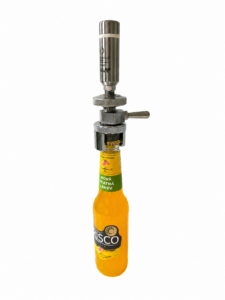
For direct CO₂ measurement in bottles, PET bottles, and cans, 1-CUBE offers two instruments: the ICA (analog) and the ICD (digital). Both operate on the principle of piston-assisted CO₂ release after piercing the closure, ensuring fast, reliable, and highly reproducible measurements.
The ICA is the simpler and most cost-effective solution, making it particularly attractive for microbreweries and small beverage producers. The CO₂ concentration is determined from the integrated nomogram using the measured pressure and temperature.
The ICD automatically measures pressure and temperature, calculates the CO₂ concentration, and displays the result on a color touchscreen in both g/L and volumes of CO₂ (measurement range 2.0–9.99 g/L, accuracy ±0.05 g/L). The instrument stores up to 250 measurements and can be used directly with cans without additional accessories, while PET bottles require an optional adapter. When equipped with the optional sampling probe, the ICD also functions as a sampling device for collecting beer samples for analysis with any dissolved oxygen meter, enabling measurement of dissolved oxygen in finished packages.
5.4 Summary Comparison
| Model | Measured Parameter | Measurement Location | Instrument Type | Recommended For |
| GMA | CO₂ | Tanks, KEG kegs | Analog (nomogram) | Small producers, limited budget |
| GMD | CO₂ | Tanks, KEG kegs | Digital (automatic calculation) | Higher accuracy and faster measurements |
| OXI-GMD | CO₂ + O₂ | Tanks, pipelines, KEG kegs, and—with ICAS—finished packages | Digital, combined | Comprehensive quality control with a single instrument |
| ICA | CO₂ (+ sampling for O₂) | Bottles, cans, PET bottles | Analog (nomogram) | Small producers, limited budget |
| ICD | CO₂ (+ sampling for O₂) | Bottles, cans, PET bottles | Digital, touchscreen display | Higher accuracy and faster measurements |
![Img 20250702 084940[3]](https://www.1-cube.com/wp-content/uploads/2026/03/IMG_20250702_0849403-225x300.jpg)