
Beer forcing test
These instruments, thanks to their versatility, are used in a wide range of applications. They can be employed both as shock liquid thermostats for determining the colloidal stability of beer and as standard liquid thermostats. All manufactured models are equipped with modern electronics that ensure easy operation and high functional value of the equipment. Automatic maintenance of a constant bath level throughout the entire test is a standard feature, even when different numbers of bottles are placed in the test.
For determining the colloidal stability of beer and for rapid prediction of its shelf life, temperature shock treatment is used in combination with haze measurement using laboratory turbidimeters. The shock-test methodologies applied differ both in the set temperatures (heating and cooling) and in the duration of the individual test stages.
Overview of the most common shock tests (Beer forcing tests):
| Method / Author | Temperature cycle (procedure) | Note |
| Original EBC test | 7 days at 40 °C → 1 day at 0 °C | Classic long-term test. |
| Schild’s test | 7 days at 60 °C → 1 day at 0 °C | More aggressive variant of the EBC test. |
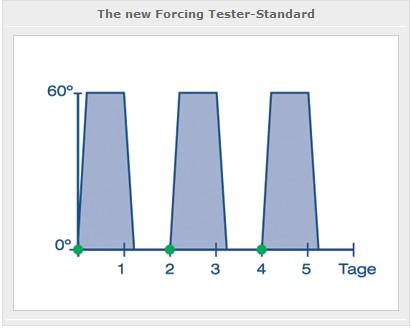
| Current EBC test | 1 day at 0 °C → 2 days at 60 °C → 1 day at 0 °C | Standardized European procedure. |
| Basařová a Kahler | 6 h at 0 °C → 16 h at 66 °C → 6 h at 0 °C | Rapid method (so-called short-term shock). |
| MEBAK Analytics (1979) | 1 day at 40 °C (or 60 °C) → 1 day at při 0 °C | German methodology. |
| Šavel and Prokopová | 24 h at 0 °C (haze) → 6 days at 50 °C → 24 h at 0 °C (haze) | Cyclic test repeated up to a limit of 2 EBC units. |
Instrument description:
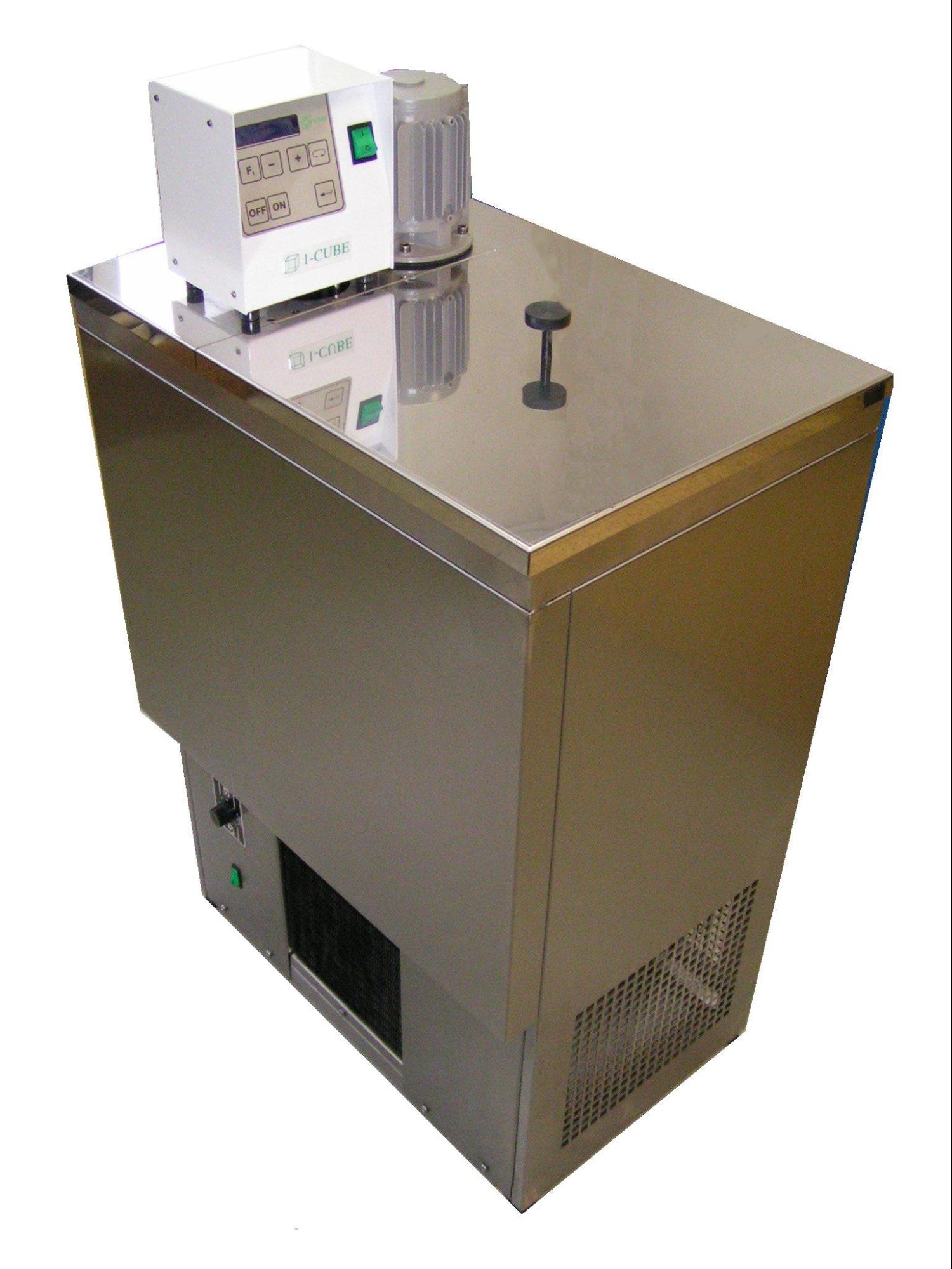
Shock thermostats for beer forcing tests, types SU6.2, SU12.2
The units are equipped with two separate and independent liquid baths (cold and hot) with a capacity of 6 + 6 bottles (type SU6.2) or 12 + 12 bottles (type SU12.2), respectively. Thanks to their versatility, they are intended for a wide range of applications. They can operate both as shock-testing units and as two independent liquid thermostats.
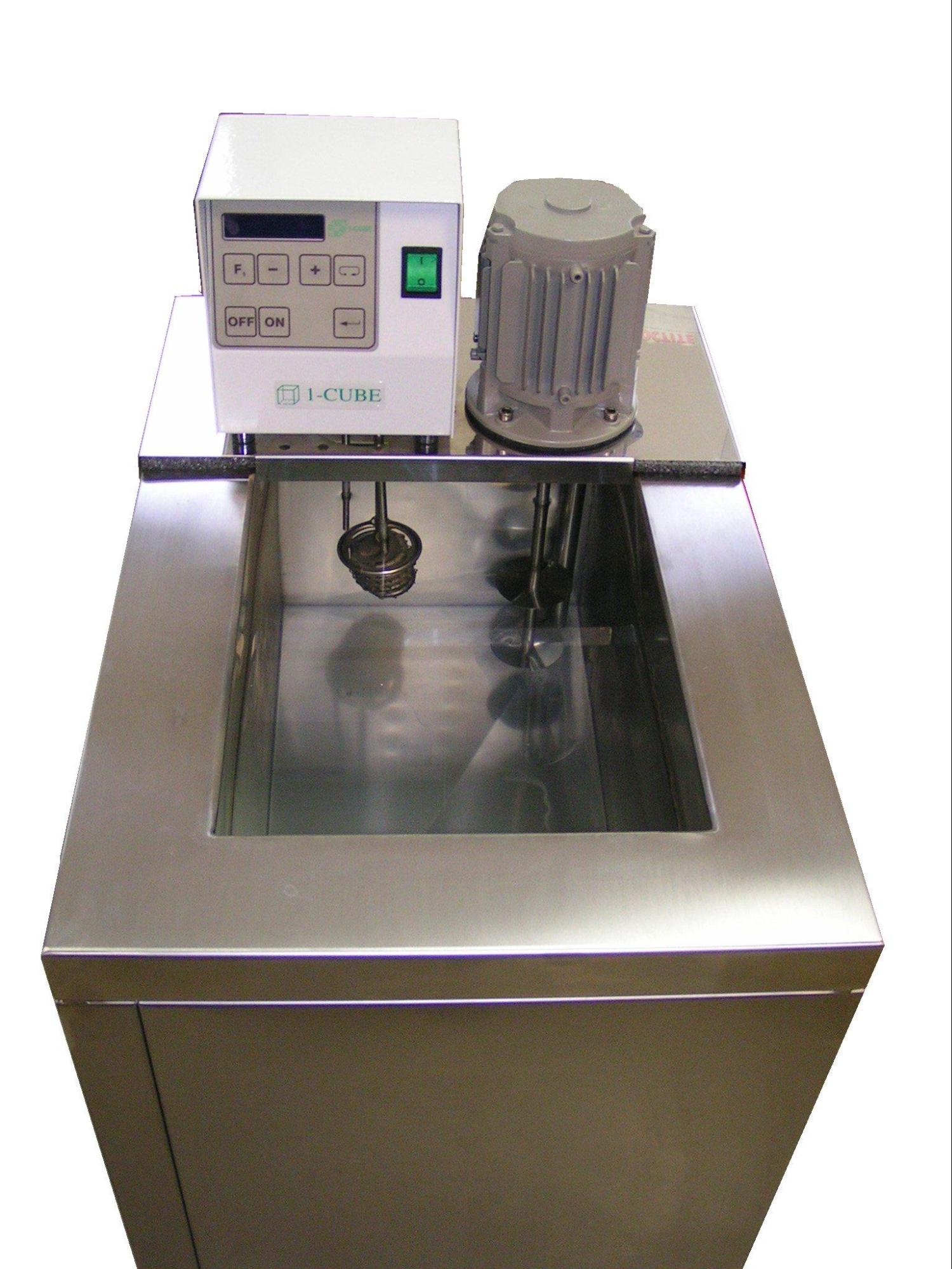
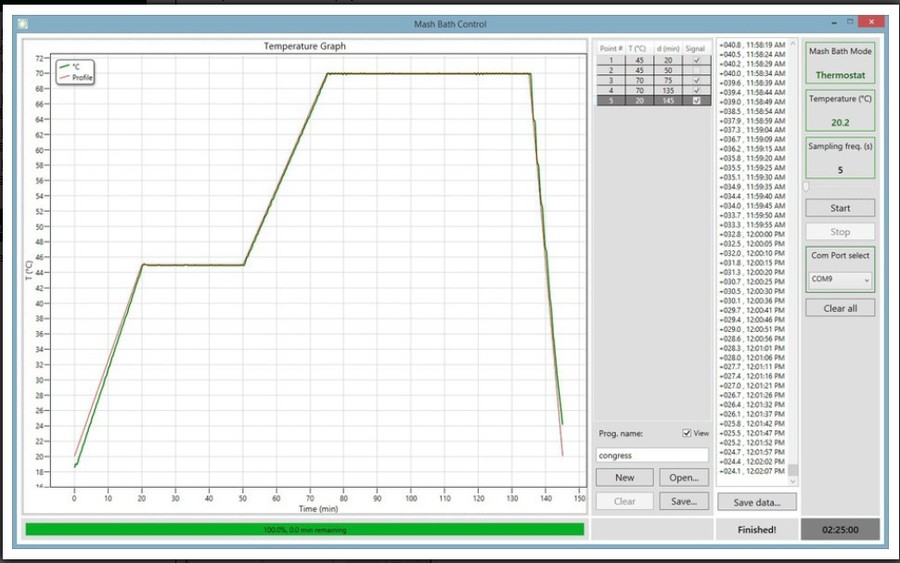
The temperature range of the thermostats is from 0 °C to +90 °C. The instrument is entirely made of stainless steel, and the liquid baths are thermally insulated. The unit is equipped with a microcomputer, a Pt100 resistance thermometer, a two-line LCD display, a membrane keypad, and control software. An RS232–USB interface is included, enabling control and monitoring of temperature profiles from a PC.
Operational safety is ensured by an automatic heating shut-off function when the bath liquid level falls below the minimum limit.
Shock thermostats for beer forcing tests, types SU6.1, SU12.1
The units are equipped with a single liquid bath with a capacity of 6 or 12 bottles, respectively. They allow operation within a temperature range from 0 °C to +80 °C and offer the option to program temperature cycles according to the requirements of the test.
Technical parameters
| Technical parameters | SU6.2 | SU12.2 | SU6.1 | SU12.1 |
| Design | 2-bath | 2-bath | 1-bath | 1-bath |
| External dimensions (W x H x D) | 80 x 100 x 60 [cm] | 80 x 100 x 60 [cm] | 60 x 65 x 80 [cm] | 70 x 65 x 80 [cm] |
| Liquid bath dimensions [cm] | 25 x 45 x 35 (depth) | 25 x 45 x 35 (depth) | 40 x 40 x 30 (depth) | 40 x 40 x 30 (depth) |
| Weight | 65 kg | 80 kg | 40 kg | 50 kg |
| Bath capacity (bottles) | 6 + 6 | 12 + 12 | 6 | 12 |
| Temperature range | 0 to +90 °C | 0 to +90 °C | 0 to +80 °C | 0 to +80 °C |
| Temperature stability at 60 °C | 0.1 °C | 0.1 °C | 0.1 °C | 0.1 °C |
| Adjustable parameters | temperature | temperature | temperature, time | temperature, time |
| Temperature setting resolution | 0.01 °C | 0.01 °C | 0.1 °C | 0.1 °C |
| Power input | 2.6 kW | 2.6 kW | 2.6 kW | 2.6 kW |
| Power supply | 230 V / 50 Hz | 230 V / 50 Hz | 230 V / 50 Hz | 230 V / 50 Hz |
| RS232/USB interface | yes | yes | yes | yes |
Theory of beer colloidal stability prediction:
1. Temperature shock as a key predictive method
Temperature shock (cycling) is among the most important and reliable physical methods for predicting colloidal stability. Its principle is the artificial acceleration of the aging process.
- Mechanism: Alternating high (40–60 °C) and low (usually 0 °C) temperatures.
- Heat: Accelerates chemical reactions and oxidative processes, leading to the formation of permanent haze.
- Cold: Induces chill haze, which serves as an indicator of future instability.
Correlation with practice:
- One week at 37 °C roughly corresponds to one month of storage at room temperature.
- One cycle (2 days at 60 °C + 1 day at -2 °C) corresponds to up to 6 weeks of normal storage.
Advantages:
- Instrumentally simple (requires only a liquid thermostat and laboratory turbidimeter).
- Can be performed directly in commercial packaging (bottles), capturing the effect of the filling line as well.
Other methods for stability assessment
In addition to shock tests, faster but less precise tests are used in practice:
- Precipitation tests: Induce the precipitation of haze-forming substances by adding reagents (ammonium sulfate, tannin for sensitive proteins, PVP for tannins).
- Alcohol chill test (ACT): Induces haze by adding alcohol and chilling below 0 °C (usually -5 to -8 °C). Results are available within one hour.
Scope of Delivery:
- Shock liquid thermostat in the selected version
- Bottle holder
Accessories (optional):
- PC software with USB/RS232 communication cable
Advantages & Benefits:
- Full automation: The instrument automatically controls temperature profiles and the shock process.
- Standardized tests: EBC, ASBC, MEBAK Analytics, Schild test, Basařová & Kahler, Šavel & Prokopová.
- High accuracy and calibratability: Ideal for laboratories with an established ISO 9001/9002 quality system.
- Flexibility: Custom profiles can be set using the PROFILE method.
- Long-standing experience: We have been manufacturing liquid thermostats for over 25 years. Our instruments are used by major companies such as Heineken, Asahi, Anheuser-Busch, as well as small breweries.
Downloads
Product sheets, catalogues and technical documentation.
Frequently asked questions
What is the difference between single-bath and double-bath thermostats?
- Double-bath thermostats are equipped with two independent liquid baths – one hot and one cold. Temperature shock is performed by manually transferring bottles between the two baths. This design provides very high temperature shock dynamics, allowing rapid and significant temperature transitions. The main drawback is the need for manual handling of samples during the test.
- Single-bath thermostats have only one liquid bath and allow programming of temperature cycles according to the requirements of the specific test. Compared to double-bath units, they offer lower temperature shock dynamics, but their main advantage is a fully automated test procedure without the need to move bottles between baths, which improves user convenience and operational safety.