
Foam stability analyzer – TYPE FSA COMFORT
The device automatically monitors the decrease in the foam surface over time, which corresponds to the consumer’s assessment. Foam in the measuring cuvette can be created in three different ways, which correspond to the methodology for measuring its decay.
Application:
The principle of the measurement is based on the automatic monitoring of the foam surface decrease using a conductivity sensor. The instrument automatically tracks the drop in the foam surface over time, which corresponds to consumer evaluation. Foam in the measuring cuvette can be generated in three different ways, each corresponding to a specific methodology for measuring its collapse:
- Measurement of the collapse of foam created by high-pressure injection of beer through a nozzle according to the NIBEM method
- Automatic measurement of foam collapse formed by pouring beer from a bottle into a glass
- Measurement of the collapse of foam generated from liquids not saturated with gases
Measurement of foam collapse created by high-pressure injection of beer through a nozzle according to the NIBEM methodology (available in both the FSA-Comfort and FSA-according to Nibem models):
According to the NIBEM methodology, the time required for the foam surface to decrease by 10, 20, and 30 mm is measured using a system of movable electrodes. The central probe is immersed in the foam and slowly moves downward into it. If one of the side electrodes comes into contact with the foam surface, the downward movement stops until the contact is interrupted due to the foam collapse – after which the electrodes begin moving downward again and the cycle is repeated.
The measurement begins at the moment when the foam level drops 10 mm below the rim of the cuvette. The measurement continues until the foam has dropped by an additional 30 mm, i.e., 40 mm below the rim of the cuvette.
For measurement reproducibility, the method of foam generation is crucial to ensure that the foam structure remains consistent. Beer is taken from a bottle or can under a pressure of 2 bar using an ICAS sampler and a Flasher device, in which the beer is forced through a nozzle of very small diameter, thereby generating foam.
Foam generation according to the NIBEM methodology:
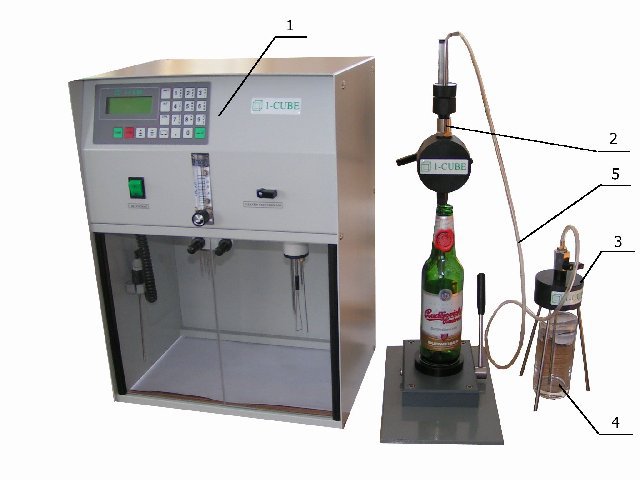
1– FSA Foam Stability Analyzer, 2–ICAS Sampler, 3–Flasher, 4–Measuring cuvette, 5–Connecting tubing
Automatic measurement of foam collapse formed by pouring beer from a bottle into a glass (available only in the FSA-Comfort model)
Foam is formed by the fall of beer saturated with carbon dioxide, automatically taken directly from a sealed bottle. This method simulates the natural pouring of beer. The beer is dispensed from a bottle or can into the measuring cuvette.
To adjust the foaming rate and standardize the measurement procedure, the filling time is recorded. Filling is automatically stopped upon the first contact of the electrode sensor with the foam surface. The electrodes are movable and gradually descend depending on the foam collapse. If the electrodes are in contact with the foam surface, they remain stationary. When the foam level drops below the electrodes, the electrodes move downward until the next contact with the foam.
The instrument measures the time of foam collapse at three different heights, freely preset by the user, for example after a 10, 20, and 30 mm decrease. A fourth height/time pair corresponds to the total foam height (down to the “bald spot”) formed in the cuvette and the time of its complete collapse.
This arrangement corresponds to pouring foam to a prescribed height and measuring the time of its complete collapse from the consumer’s perspective.
Measurement of foam collapse generated from liquids not saturated with gases (available only in the FSA-Comfort model):
In addition to the measurement methods described above, the instrument can generate foam from liquids not saturated with gases, for example from wort or hopped wort, and subsequently measure the rate of its collapse.
Beer or another liquid (e.g., wort) is foamed directly in the measuring cuvette by stirring, by stirring combined with bubbling, or by bubbling air alone (or another gas). The time required for the foam to decrease by 40 mm—defined by the distance between the electrode levels—is then measured.
The stirring speed and the flow rate of the bubbling gas can be adjusted, allowing preparation of foam with different structures, ranging from coarse to very fine. The foam then collapses over varying periods depending on its structure.
To ensure measurement reproducibility in repeated experiments, the last used values of the stirring speed and gas flow rate remain stored in the instrument’s memory. At the same time, the foaming time (the time from switching on stirring/bubbling to switching it off) is displayed and stored in the instrument memory.
Technical data:
| Category | Parameter | Type FSA-according to Nibem | Type FSA-Comfort |
| Technical data | Power supply | 230V / 50Hz | 230V / 50Hz |
| Technical data | Protection | IP20 | IP20 |
| Technical data | Power consumption | 200 W | 200 W |
| Technical data | Display | LCD 4×20 characters | LCD 4×20 characters |
| Technical data | Memory | 400 measurements | 400 measurements |
| Technical data | Interface | USB / RS232 | USB / RS232 |
| Technical data | Dimensions (H x W x D) | 530 x 390 x 300 mm | 530 x 390 x 300 mm |
| Technical data | Weight | 5 kg | 5 kg |
| Adjustable parameters | Gas flow | NO | YES – for generating foam in liquids not saturated with gases using a float flowmeter with a needle valve |
| Adjustable parameters | Stirrer speed | NO | YES – for generating foam in liquids not saturated with gases using a membrane keypad |
| Accuracy | Foam height measurement accuracy | 1 mm | 1 mm |
| Accuracy | Foam collapse time measurement accuracy | 1 sec | 1 sec |
| Measurement range | Electrode movement | 0 to 54 mm | 0 to 54 mm |
| Measurement range | Time measurement | 0 to 999 sec | 0 to 999 sec |
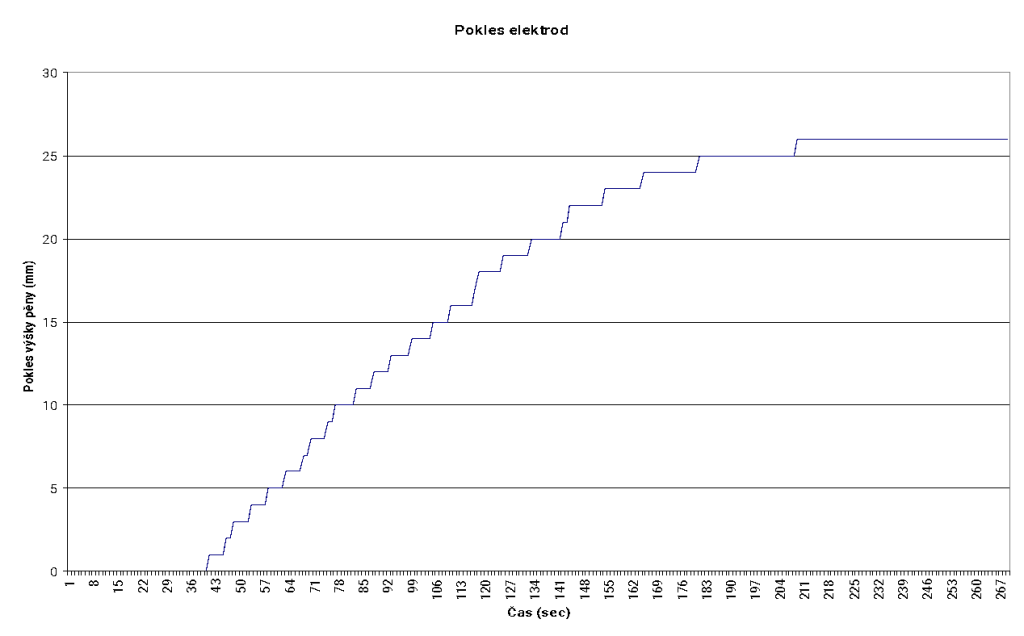
Example of a curve of beer foam surface decline over time recorded by the FSA-Comfort device in the “Automatic measurement of foam breakdown caused by pouring beer from a bottle into a glass” mode and displayed on the computer.
Scope of Delivery:
- Foam Stability Analyzer, type FSA-Comfort or type FSA-according to Nibem
- Cuvette
Accessories (optional):
- ICAS Sampler
- Flasher
- USB/RS232 cable
Main disadvantage:
- Neither model is equipped with automatic compensation for temperature, atmospheric pressure, or air humidity.
Advantages & Benefits:
- The FSA-Comfort model, in addition to measuring foam stability according to the NIBEM methodology, also allows measurement of foam collapse formed by naturally pouring beer from a bottle into a glass. It can also generate foam from liquids not saturated with gases and subsequently evaluate its collapse.
- High accuracy and calibration capability: Ideal for laboratories with an established ISO 9001/9002 quality system.
Downloads
Product sheets, catalogues and technical documentation.
Frequently asked questions
What accessories are required, in addition to the FSA instrument, for measuring foam stability according to the NIBEM methodology?
In addition to the foam stability measuring instrument itself, accessories are needed to generate the foam. This includes a pressurized gas cylinder with a pressure-reducing valve, an ICAS sampler for dispensing the beverage sample from the bottle, a Flasher for foam formation, and a measuring cuvette.